

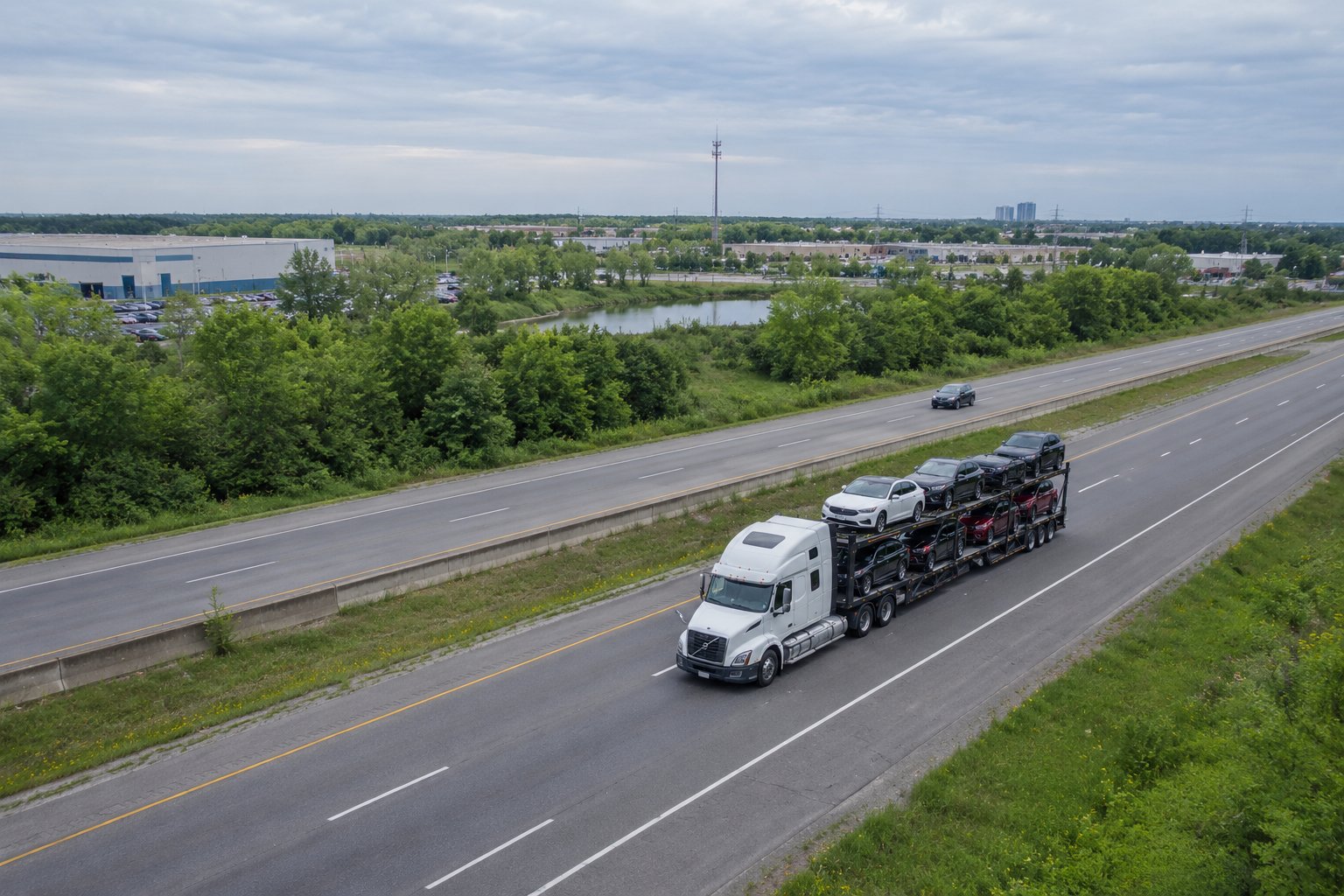
Ask any dealership general manager what keeps them up at night and you'll hear a familiar list: floor plan costs, margin compression, customer satisfaction scores. Transport delays rarely make the top three - even though they quietly feed all of them.
The problem isn't that Canadian dealers don't care about logistics. It's that the real damage is spread across departments, buried in line items, and absorbed so routinely that it stops registering as avoidable. A vehicle that arrives three days late isn't a crisis - until you count up what those three days actually cost.
This post breaks down exactly where those costs live, why they're growing in 2026, and what operationally sharp Canadian dealerships are doing about it.
The chain reaction nobody tracks
When a vehicle transport runs late, most dealerships record it as an inconvenience. What they rarely record is the cascade. A single delayed delivery doesn't produce a single cost - it triggers a sequence of them. According to research on dealership transport operations, even a 2–3 day delay can set off a chain reaction that directly lowers monthly sales performance - and those effects compound across every vehicle delayed that month.
- 1The customer promise breaks. A salesperson committed to a delivery date based on an estimated transport window. Now they're making an apologetic call. That call costs trust - and sometimes costs the deal entirely.
- 2Reconditioning gets pushed. Your service team had the vehicle scheduled for prep. It's not there. That slot gets reallocated, and when the car finally arrives, it joins the back of a new queue - adding days, not hours, to retail readiness.
- 3Your floor plan clock keeps running. The vehicle that was supposed to hit the lot Thursday becomes a next-week problem. Interest charges don't pause while transport sorts itself out.
- 4Dispatch staff lose hours they don't have. Someone is calling the carrier. Then calling again. Then escalating. That's paid time spent chasing a vehicle instead of moving the next one.
Individually, any one of these feels minor. Together, they represent a meaningful drag on monthly performance - and they're happening across multiple vehicles simultaneously.
"As a dealer, the costs that hurt you most are the ones you never see on an invoice - they hide in delayed deliveries, missed promises, and idle inventory, quietly draining your bottom line every single month."
Where the money actually goes
Let's make this concrete. According to Harney Partners' 2025 floor plan analysis, new-vehicle holding costs averaged $7.90 per day per unit in Q1 2025 - and net floor-plan expense per vehicle rose roughly 39% in Q2 2025, adding ~$139 per unit as slower inventory turnover pushed carrying costs higher. Across even a modest volume of delayed transport orders per month - and according to LiftN'GO CEO Igor Iounatanov, roughly 5% of dealership vehicle orders experience a transport delay in any given month - those daily charges stack fast, with zero revenue to offset them.
Here's how transport delays translate into real costs across a typical Canadian dealership operation:
| Cost category | How delays trigger it | Impact |
|---|---|---|
| Floor plan interest | Every delayed day extends carrying cost with zero revenue offset. Industry data puts new-vehicle holding costs at $7.90/day per unit in Q1 2025 - and rising. | High |
| Missed sales | A customer waiting on a delayed vehicle may cancel, settle for a competitor, or lose financing approval before the car arrives. | High |
| Staff time - dispatch & sales | Chasing updates, rebooking reconditioning, resetting customer expectations - all paid labour with no revenue attached. | Medium |
| Reconditioning bottlenecks | Vehicles arriving out of sequence throw off service bay scheduling, reducing throughput beyond just the delayed unit. | Medium |
| Transit damage claims | Rushed rescheduling with mismatched carriers increases damage risk - adding repair costs and delaying retail readiness further. | Medium |
| CSI and OEM allocation impact | Broken delivery promises affect customer satisfaction scores tied to OEM bonuses and future inventory allocations. | High (long-term) |
Why this is getting worse in 2026, not better
The Canadian automotive market is operating under conditions that amplify every logistics inefficiency. Three structural shifts are making transport delays more costly than they were two or three years ago.
Inventory sourcing has shifted
Canada's share of light vehicles sourced from the US dropped to 43.7% as OEMs adjusted to trade tensions - and the share of vehicles sourced from within the CUSMA region hit a record low of roughly 65% as of November 2025, according to TD Economics. That means vehicles are moving through newer, less-familiar supply chains - with less predictable transport timelines and fewer established carrier relationships. BMO's year-end analysis warns that tariff pressures will remain headline risks through at least mid-2026, keeping the sourcing environment volatile. The cushion of pre-tariff US inventory is gone. Logistics gaps that were masked by buffer stock are now fully exposed - and 52% of franchised dealers reported sourcing conditions worsening in the six months to February 2026.
Carrier capacity is structurally tight
Driver shortages in Canadian transport are not a temporary cycle - they're a structural reality. Statistics Canada reported 11,600 vacant truck driver positions in Q3 2025, with some carrier fleets operating at up to a 15% shortfall in driver capacity. Trucking HR Canada projects the industry could face up to 40,400 vacant positions by 2030 without targeted intervention - driven by an aging workforce where 32% of Canadian truck drivers are already 55 or older. Fewer qualified drivers means less flexibility when your preferred carrier can't meet your window. It also means the carriers who can are running at or near capacity, with less tolerance for schedule changes or last-minute rerouting.
Digital retail demands faster, more precise transport
The shift to online vehicle sales and home delivery means more vehicles need to move more often, on tighter windows. A vehicle that used to sit on the lot until a walk-in customer arrived now needs to be dispatched to a buyer - on time, in condition, with real-time status visible to the sales team that promised the delivery. The old model of calling a carrier and hoping for the best doesn't survive contact with that expectation.
Most vehicle logistics research and platform development is US-focused. Canadian dealerships operate under distinct conditions: cross-provincial regulations, winter routing constraints that don't exist in southern US markets, a more concentrated carrier landscape, and a tariff environment with no direct US parallel. Generic logistics solutions miss all of this - and so do most of the "best practices" articles dealers find when they search for help.
According to a February 2026 survey by DesRosiers Automotive Consultants, 52% of franchised Canadian dealers reported that used vehicle sourcing conditions worsened in the six months to early 2026. Only ~10% saw improvement. Franchised stores averaged 354 used unit sales per location in 2025 - and are projecting 405 in 2026, putting even more pressure on a supply chain already strained by tariff disruption and reduced off-lease inventory.
What high-performing Canadian dealers do differently
The dealerships that consistently outperform on inventory velocity share a few operational habits around transport. None of them are complicated. Most are simply about removing the default assumption that logistics is someone else's problem.
They book transport before the vehicle is ready
Waiting until a vehicle is on-site before arranging transport adds one to two days to every move. Operationally sharp stores initiate transport orders the moment a purchase is confirmed - or even earlier for dealer trades and auction buys - so the carrier is lined up before the vehicle is. The booking window and the vehicle readiness window run in parallel, not in sequence.
They use a single platform for all transport types
Managing drive-away, flatbed, haul-away, and enclosed transport through separate carriers and phone calls creates coordination gaps that are invisible until they become emergencies. A single dispatch platform gives the operations team full visibility across all vehicle movements - and makes it possible to compare carriers, track orders, and catch delays before they cascade.
They track at the order level, not the carrier level
The question shouldn't be "where is the hauler?" - it should be "where is unit #VIN4729, and when exactly does it arrive?" Dealers with real-time order-level tracking catch delays early enough to reset customer expectations proactively. The ones without it find out about delays from frustrated salespeople.
They treat transport as part of the sales process
The best General Managers (GMs) build transport timelines into delivery commitments from the start. When the sales team understands what a realistic transport window looks like - and can see live order status - their customer promises become more reliable. That reliability shows up directly in CSI scores and repeat business.
So what does putting all four of these habits together actually look like in practice? The difference comes down to one thing: swapping a fragmented, phone-based dispatch process for LiftN'GO - Canada's only dedicated B2B vehicle logistics platform, handling everything from booking to real-time tracking in one place. General Managers who have made that switch describe the result the same way - fewer calls, fewer surprises, and delivery promises their sales team can actually keep.
The fix isn't hiring more people
One reaction to transport friction is to add headcount - another coordinator, another person on the phones. But the root problem isn't a staffing gap. It's a process and platform gap.
When a dealership moves from managing transport through phone calls and spreadsheets to LiftN'GO, the time savings are immediate. What once meant hours to days of broken telephone - calling carriers, waiting on callbacks, chasing confirmations, and still not knowing if you got the best deal is handled in minutes through a single platform. Dispatch staff stop being intermediaries and start being exception managers, only stepping in when something genuinely needs their judgment.
More importantly, visibility improves across the entire dealership. When the General Manager (GM), the sales team, and the service department can all see where every vehicle is in the transport pipeline, the whole store makes better decisions - on delivery promises, reconditioning scheduling, and staff deployment.
"Every day a vehicle sits waiting for transport is a day it isn't selling. The dealerships moving inventory fastest aren't lucky - they've just eliminated the delays everyone else accepted as normal."
Why Canada needs a Canadian platform
LiftN'GO is Canada's dedicated B2B vehicle logistics platform whose sole purpose is to connect dealerships, car rental companies, fleet operators, and auction houses with a vetted network of professional transport carriers, all through one digital platform.
That distinction matters. Canadian logistics has Canadian-specific challenges: provincial regulations, winter routing constraints, cross-border nuances, and a carrier market that doesn't have the same depth as the US. A platform built here understands those constraints - and routes around them.
The result for dealerships using LiftN'GO
Faster order bookings, real-time tracking across all transport types - drive-away, flatbed, haul-away, and enclosed - and a single dispatch platform that matches the right carrier to the right vehicle. No phone calls. No guesswork. No delays that quietly drain your floor plan budget while your sales team scrambles to explain a missed delivery window.
Frequently asked questions
Stop losing money to transport you can't see.
LiftN'GO gives Canadian dealerships a single platform to book, track, and manage all vehicle transport - drive-away, flatbed, haul-away, and enclosed. No phone calls. No guesswork. Free to get started.